
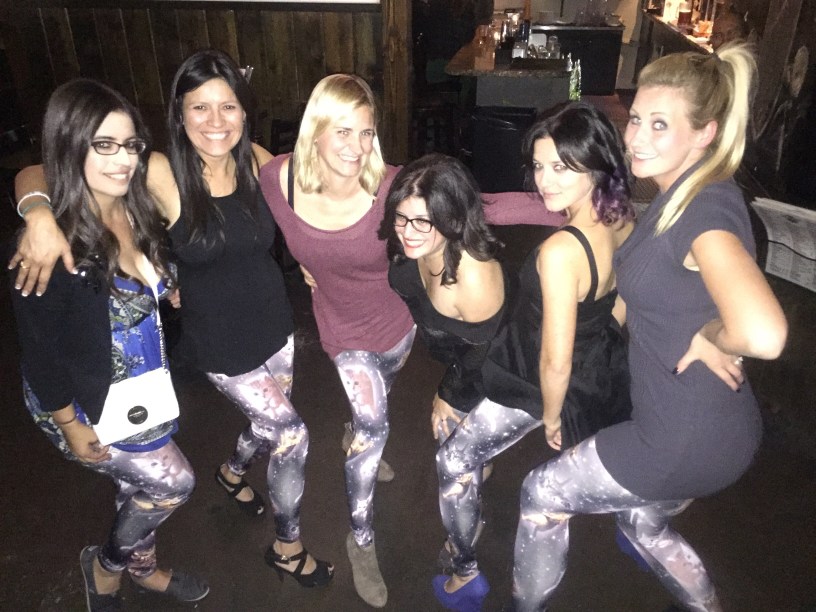
I’ve been meaning to write an update for a while, but couldn’t find the inspiration. Then, as everyone who has been reading along knows, I lost someone very special this past week and the inspiration came. Nearly 3,000 people have read my last post since it was published, which is an incredible testament to the number of people whose lives Sean touched. I wrote my tribute without the intention of garnering such a large audience. It was just an outlet for me to express my grief. I was fortunate to travel back to Canada this weekend for Sean’s celebration of life. Over the course of the 48 hours I was in town, I met many people who found comfort in my words and for that I am equally humbled and thankful. As I promised Sarah I would, I wore my cat pants to the funeral. No one can be 100% sad when there are flying space cats on the prowl. 99% sad, yes, but 1% cat pants.
Now, I am back on a plane flying over the United States, Rolling Stones piping into my headphones. Sympathy for the Devil came on and I pressed repeat twice. Losing Sean has brought death to the foreground of my thoughts. Nothing like the loss of someone you love to cause you to consider your own mortality. Like Sean, I have been dealt an unfortunate hand in the game of health. He had a defective heart and I have defective genes. Unless and until a cure is found, ataxia will have the upper hand, but I am hoping I’ll get dealt an ace before I have to fold.
Here’s a quick refresher on some key ataxia facts: ataxia is a progressively degenerative condition. Ataxia slowly makes it harder to do things like walk or chew and swallow. Everyone experiences symptoms differently and the rate of degeneration is unpredictable. Even within the same family, two people could experience different symptoms or can experience more severe rates of degeneration, so just because I observed certain issues with my mom does not mean I will experience the same issues and just because she lived with her condition for 20 years does not mean I have a similar life expectancy. Of course, this all could change overnight if a cure is found. There have been significant developments in terms of symptom management in the past few years and initial research relating to gene suppression has been positive. There is hope that a cure may be found during my lifetime. Given the current state of research, I am cautiously optimistic about that prospect and the goal is to be in the absolute best shape possible if that time comes. That means turning what has started out the gate as a sprint into a marathon. In the words of music icon Paula Abdul, I’m going to take two steps forward when ataxia takes two steps back.
One of the first signs that I had ataxia was a discernable change in my coordination. Over the past two years, my balance has taken quite the tumble (see what I did there). Stairs are super hard for me. Squatting is hard. Things I used to be able to do with ease I no longer feel confident doing, such as wearing heels or walking on uneven surfaces. However, I began physical therapy on July 8 and, for the first time in two years, I have noticed an improvement in my balance. The first session I had with my therapist, Nasim, was rough. I came on pretty strong about my desires for therapy and she pushed back. We did not connect at all and I was convinced that it would be our one and only session together. But half way through the session something shifted. I was on the floor, balancing on one knee. She wanted me to stand up from a half-kneeling stance and I was unable to do it. I broke down crying. It’s infuriating not being able to do things that you used to do effortlessly. I was a dancer for the first half of my life for goodness sake. Nasim and I talked about how frustrated I was and how badly I wanted to improve and it clicked. We’ve been working incredibly well ever since and the work is paying off. For example, I only needed to hold the rail to step on the escalator at the airport, but once I was on I was able to stabilize and did not need to hold anything. Prior to therapy, I can barely remember the last time I was able to use an escalator without holding on. I was also able to balance on a rickety dock at Black Lake without holding onto anything. I try to go up and down stairs without using a rail as much as possible to convince my body that I am able to do it (though I do tend to walk with my arms extended in front of me like I’m the walking dead as I climb or descend a staircase, which is pretty hilarious). I’ve also noticed that when I do something challenging in therapy I instinctively cross my fingers which makes Nasim laugh. Overall, physical therapy has been incredibly helpful and I am very glad that my first 60 treatments are covered by insurance (minus a co-pay). I am convinced that when I get my next SARA score in November it will have lowered. As you may recall, my current score is a 5 out of 40, but I really want to push that number down as far as it will go. I have also felt like I have more energy, which is likely the combined result of changing my diet, taking a regular supply of vitamins and supplements, and the exercise/PT regimen. Probably the best news is that I haven’t fallen once since PT started though there have been a couple close calls. A few weeks ago, my ankle gave out again, but I was able to recover without falling. I also tripped this weekend but was able to regain my balance.
On the flip side, since we are being honest, I have noticed some short term memory issues. I am not sure whether it is something new or just something I have become more aware of as a result of learning the symptomology of ataxia, but I realize that I can be very scatterbrained. Like, I think that I should tell someone something and then awhile later I cannot remember if I actually talked to them about it or not, or I will ask a question and a short time later ask the same question again and have to remind myself that I already know the answer. These types of problems are common in ataxia patients who have experienced cerebellar atrophy, because the cerebellum controls an individual’s ability to recall newly learned information. It is possible I am already experiencing some of this, though my MRI in February did not disclose any atrophy. From a work standpoint, I have adapted by taking notes of every conversation so that I have a written record to rely on rather than my independent recollection, which seems to be doing the trick.
On the flip side, I have noticed some short term memory issues. That’s a joke.
All in all, I’ve experienced a few hiccups here and there but I am plodding along well. I’ve reached Mile Marker 1, but there is plenty of road left to go. So, onward I go toward the win.
I’ll leave you with this (slightly adapted) rendition of the Tortoise and the Hare.
The Hare was once boasting of his speed before the other animals. “I have never yet been beaten,” said he, “when I put forth my full speed. I challenge any one here to race with me.”
The Tortoise said quietly, “I accept your challenge.”
“That is a good joke,” said the Hare; “I could dance round you all the way.”
“Keep your boasting till you’ve won,” answered the Tortoise. “Shall we race?”
So a course was fixed and a start was made. The Hare darted almost out of sight at once, but soon stopped and, to show his contempt for the Tortoise, lay down to have a nap. The Tortoise, who was obviously wearing cat pants, plodded on and plodded on, and when the Hare awoke from his nap, he saw the Tortoise just near the winning-post and could not run up in time to save the race.
Then the Tortoise said: “Slow but steady progress wins the race. Jazz hands.”


Jazz hands for the win, my friend 😊
LikeLike
I missed this update when it was first posted, but very glad I read it. Another beautifully written entry — I’m so glad you’re sharing your journey with us.
And I think I scared my office neighbor laughing so hard at your short term memory joke.
You are amazing!
LikeLike