
Last night, as we were readying to leave the house for dinner, I walked into the living room where Corby was waiting. Corby noticed immediately. “You are wearing heels,” he said. “Yep,” I replied, as I did my best (terrible) catwalk impression. “I think someone who gets a 5 deserves to wear heels.” It goes without saying that I have been on a real high since getting that score on Tuesday.
When I was younger and my mom was diagnosed with ataxia she did nothing, literally nothing, to slow its progression. She drank heavily, ate poorly, rarely exercised, and went years without seeing a doctor. Looking at her actions now, I am dumbfounded that this woman with an absolute zest for life found herself in a place where she had no desire to fight to extend her life. Sure, she had a positive attitude, but positivity will only get you so far.
I know that the state of research is far more advanced now than it was then, but the truth is that I am not in any different a place than she was when she was diagnosed. Just as she was faced with the awful truth that there is no cure, I too must acknowledge that truth. I want there to be a cure. I am hopeful there will be a cure. BUT, there is currently no cure. And so my efforts may ultimately be futile. In this sense, I must take a page out of my mom’s playbook and live with positivity and hope. However, unlike my mom, my actions cannot and will not stop there. I will do everything in my power to be in the absolute best physical shape I can be so that I am a viable candidate for treatment if they do find a cure.
Since I was diagnosed, one of my biggest fears was losing the ability to walk. Individuals with SCA1 lose their sense of balance and coordination, which is generally the first symptom they experience as their neurodegeneration begins. I have written a lot about the SARA scale without getting into too much detail, but I think now is the time to further your edification on the basic measuring tool for ataxia.
SARA, or the Scale for Assessment and Rating of Ataxia, is an 8-item performance based scale that ranges from 0 (no ataxia) to 40 (most severe ataxia). So, if you are being scored on the SARA scale, you want to get the lowest score possible. The SARA score is based on an individual’s performance of gait, stance, sitting, speech disturbance, finger chase, nose-finger testing, fast alternating hand movements, and a heel-shin slide. When I was first tested, I scored a 6.5. While that seems low, it really isn’t when considering what the most severe ataxia can look like. Consider this, a recent ataxia study found the mean SARA score for individuals with independent gait to be 5.5. The mean score for individuals with a cane was 10 and the mean score for individuals who require a walker for ambulation was 15. At 20, we are talking wheelchairs. So, not even half-way up the scale and we are looking at wheelchairs. This is beyond scary. It is also the reality.
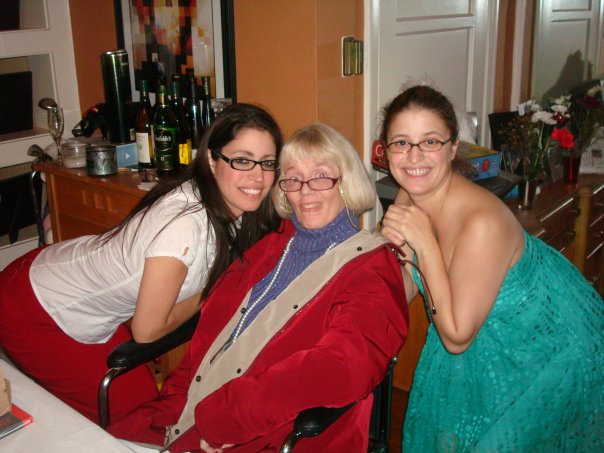
My mom, for example, began using a cane in 1996 and was in a wheelchair by 2001, about 10 years before her death. I look back at pictures, such as the one featured here, and they fill me with fear. This picture was taken a year and a half before my mom passed away. By this time, my mom could not care for herself in any form. We fed her dinner, which she could barely swallow, and she drank with a straw. She needed assistance to use the bathroom and required adult diapers. I am desperately fighting to avoid a similar future.
Everything I have read or heard suggests that SARA scores fluctuate and an individual can have a good year followed by a bad one; there is no rhyme or reason to the progression of the disease. However, the general progression expectation for SCA1 according to recent studies is a 2-point progression per year. But, with exercise and regular physical therapy, the research suggests that an individual can push their score back by several points, at least in the short term. Since the research also shows that home study is not as effective as direct study under a physical therapist, I intend to continue advocating for PT sessions, at least until we no longer see a benefit, which hasn’t happened yet.
As I told my doctor when I got the 5, I have always been an A-student and I am fighting here for my A. Instead of finding myself closer to needing assistive measures to walk after one year, I am further from it than when this journey began. Scoring a 5 means I have hopefully pushed back the clock by at least two years (considering where I should be versus where I am). If the drug trial is successful, I may be able to keep pushing back – or at least maintaining – my current status. That means more time, and time is now, to me, the most valuable commodity I can acquire.
Earlier this week, I asked for your help. I asked you – my friends and family – to join my husband on a “beer run” for ataxia or consider making a donation to support ataxia research. To those who have given so far – THANK YOU. If you have yet to give, please understand why I am asking and what this means to me. Ataxia research means hope. It means the prospect of more time and maybe a cure. Because of the generous match of the Clementz Foundation, a $10 dollar donation will mean $20, $100 will mean $200, and $1000 will mean $2000 – and it is all tax deductible. So, please consider giving what you are able (and please let me know if you do, so I can add you to our running donor tally). No amount is too small. Really.
Click here to donate: https://ataxia.donorpages.com/2017150000ReasonsToGive/
Thank you for shouldering some of this struggle with me. It truly does take a village.
 the vanishing magician